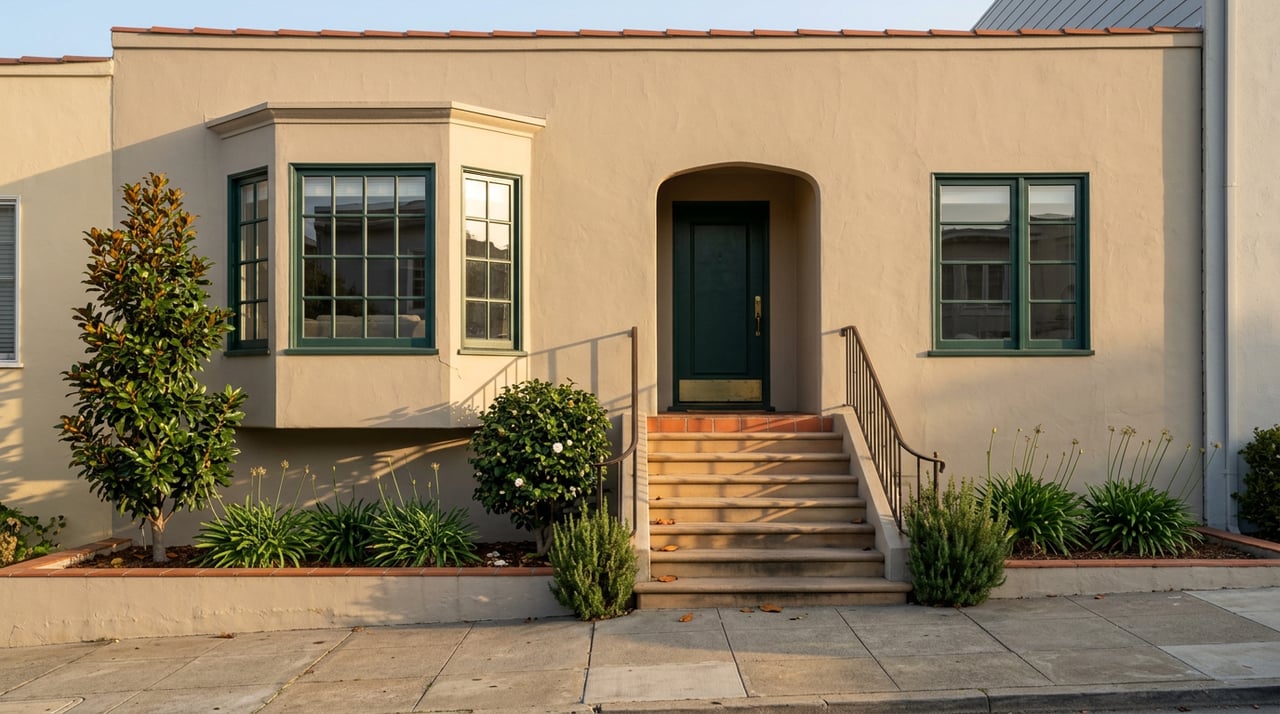
Most mornings on Lake Street, the loudest thing on the pavement is a bike bell. A parent pedals a cargo bike toward Alamo Elementary with a kid balanced in back. A retriever pulls its owner toward Mountain Lake Park. A jogger cuts through on the way to Baker Beach before the fog burns off. None of them are thinking about traffic engineering. They're just using the street the way it was built to be used, at the speed the street's own name promises.
That name is doing more work than most residents realize. The stretch of Lake Street that runs from 3rd Avenue out to 23rd, the same route the neighborhood's own community parade follows, isn't just a quiet residential block that happens to feel calm. It carries an official designation, one of San Francisco's permanent Slow Streets, a status the city granted after residents pushed for it. The idea behind that designation is specific: discourage cars from using the street as a through-route while still letting people reach their own driveways. On paper, Lake Street is supposed to behave differently from California Street one block south or Geary a few blocks north. The question the neighborhood's own advocacy group has started asking is whether it actually does.
What the City's Own Rule Says, and What the Radar Gun Found
San Francisco's Slow Streets program comes with thresholds the city set for itself: no more than 1,000 cars a day on a designated Slow Street, and no more than half of those cars traveling faster than 15 miles per hour. Those numbers exist so that a street can carry the "Slow" name without it being a marketing label.
The volunteer group Slow Lake Street has been measuring what actually happens on the corridor, and the gap is not small.
| SFMTA's own Slow Streets standard | What Slow Lake Street measured |
|---|---|
| No more than 1,000 cars per day | More than 2,000 cars per day on average weekdays |
| No more than 50% of cars over 15 mph | About 80% of cars over 15 mph |
Double the traffic volume the standard allows. Eighty percent of drivers exceeding the speed threshold that's supposed to cap out at half. That's not a street underperforming its designation by a small margin. It's a street where the everyday cyclists, dog walkers, and stroller-pushers are operating on the assumption of a slow street while the actual traffic behaves like a normal one.
The group traces part of the problem to a design detail that sounds minor until you notice it's missing. Other permanent Slow Streets in the city, among them Slow Page, Slow Cabrillo, Slow Clay, and Slow 23rd, each use two purple Slow Street paddles per lane, physical signage placed to signal restricted through traffic while still allowing local access. Lake Street was installed with only one. Fewer paddles means less visual friction for a driver deciding whether this is a street to cut through or a street to avoid. The city gave Lake Street the name without giving it the full hardware that makes the name hold up.
Who Actually Uses This Stretch Every Day
The reason this matters isn't abstract traffic policy. It's who is physically on the street while the mismatch plays out.
- Kids and parents biking the short, flat stretch toward Alamo Elementary and George Washington High School, using Lake Street specifically because it's supposed to be the calmer alternative to California Street
- Dog owners walking to Mountain Lake Park, which runs along the street's north side and includes a dog run, playground, and tennis and basketball courts inside the Presidio's edge
- Runners and cyclists using Lake Street as the connector into the Presidio's trail network, often heading toward Baker Beach with the Golden Gate Bridge in view
- Saturday regulars walking to the produce stand at 25th and Clement, then looping back for pastries at Breadbelly or a slice at Pizzetta 211
- Neighbors simply out for the kind of unhurried walk that a car-light street is supposed to make possible
Every one of those uses depends on cars actually slowing down and actually staying off the corridor unless they live on it. The measured numbers suggest that's not consistently happening, which means the people most exposed to the gap are the ones on foot, on a bike, or holding a leash.
Two Days a Year the Street Becomes the Point
Even with the traffic data hanging over it, Lake Street's identity as a resident-claimed space shows up clearest on the days the neighborhood takes it over entirely.
Once a year, Slow Lake Street organizes a community parade along the corridor. Neighbors meet at 3rd and Lake at 10:45 in the morning and move together down the street to 23rd Avenue, on bikes, on foot, on scooters, however they want to travel. It's not a protest with a bullhorn. It's closer to a block party that moves, a way of physically demonstrating what the street is for by filling it with the exact kind of low-speed, human-powered traffic the Slow Streets program was built to protect.
Then there's the fall tradition that has nothing to do with traffic policy and everything to do with how residents treat the block as an extension of their own front yards. Each Halloween season, a number of Lake Street houses turn their entries into open house-style displays, decorated for trick-or-treaters in a way that reads less like individual houses competing for attention and more like a street that has quietly agreed to put on a show together.
Both traditions point to the same underlying fact. Lake Street residents don't treat their block as a pass-through. They treat it as shared space, which is exactly the behavior the Slow Streets program is designed to reward and exactly why the traffic mismatch stings more here than it might somewhere else.
The Street You Live On Is Still Being Finished
What makes this worth knowing if you already live on or near Lake Street is that the designation isn't a finished project handed down by the city. It's a status the neighborhood fought for, got partially, and is still pushing to complete. The volunteers behind Slow Lake Street are the ones collecting the traffic counts and making the case for the second paddle, not a city department running its own audit. If you bike your kids to school on that stretch, walk your dog to Mountain Lake Park, or jog it toward Baker Beach most mornings, you're one of the people whose daily experience is the actual evidence in that argument.
None of this changes what Lake Street already offers: a walkable seam between the Presidio, Sea Cliff, and the Inner Richmond, with produce, pastries, and pizza a few blocks in either direction and some of the city's most direct access to Baker Beach. But knowing the traffic numbers changes how you read the street while you're on it. The calm is real, and it's also a work in progress, held together as much by the people using it well as by the signage the city has installed so far.
If you're weighing what it actually feels like to live along a street like this, or comparing it to a nearby block with a different rhythm, that's the kind of neighborhood-specific detail worth talking through before you decide anything. Lauren Fraser has spent more than two decades in San Francisco neighborhoods like this one and is always glad to talk through what a specific block, not just a specific listing, is really like to live on.